The Probiotic Lie in Your Refrigerator: What That Yogurt Label Isn't Telling You
Walk down the dairy aisle of any grocery store in America and you'll see the word "probiotic" plastered on yogurt containers like it's a superpower. Bold claims. Big numbers. Phrases like "billions of live cultures" printed right next to a smiling woman in athleisure. It feels like wellness in a cup.
Except here's the thing: a lot of that yogurt has been quietly processed in ways that compromise — or outright eliminate — the very bacteria being advertised. And the jar of sauerkraut you've been ignoring on the bottom shelf? It might be doing more for your gut than anything in the refrigerated yogurt section.
Let's talk about what's actually going on.
CFU Counts: A Number That Can Legally Mean Almost Nothing
CFU stands for colony-forming unit — it's the standard measurement for how many live bacteria are present in a probiotic product. When a yogurt label says "contains 10 billion CFUs," it sounds impressive. But that number is almost always measured at the time of manufacturing, not at the time you actually eat it.
By the time that container travels from a production facility in the Midwest to a distribution warehouse to your local Whole Foods to your refrigerator to your breakfast table, days or weeks have passed. Bacterial populations decline over time, especially when products are repeatedly exposed to temperature fluctuations during transport and storage. There's no federal requirement that manufacturers test — or disclose — live culture counts at the point of sale. So the number on the label? It's more of a starting estimate than a guarantee.
The FDA doesn't require yogurt to contain any minimum level of live cultures to be sold as yogurt. The National Yogurt Association has a voluntary "Live & Active Cultures" seal that sets a minimum threshold, but participation is optional and the standards are modest. Most major brands don't even bother with third-party testing to verify what's actually alive in the container when it hits shelves.
Heat Processing: The Probiotic Killer Nobody Mentions
Here's where it gets more frustrating. Some commercial yogurts — particularly shelf-stable varieties and certain flavored products — are heat-treated after fermentation. This is done to extend shelf life and improve texture. It also kills the bacteria.
You read that right. Some yogurts are fermented to develop flavor and consistency, then pasteurized again to eliminate the living organisms that fermentation created. The result is a product that tastes like yogurt, has the nutritional profile of yogurt, but contains essentially zero viable probiotics.
This practice is more common than you'd think, and manufacturers aren't required to flag it prominently. If a label doesn't carry a live cultures seal and doesn't explicitly state "contains live and active cultures," there's a reasonable chance the bacteria didn't survive to the shelf. That smooth, creamy Greek yogurt in the pretty container might be probiotic theater.
So What's Actually Working?
This is where traditional fermented foods quietly win the argument.
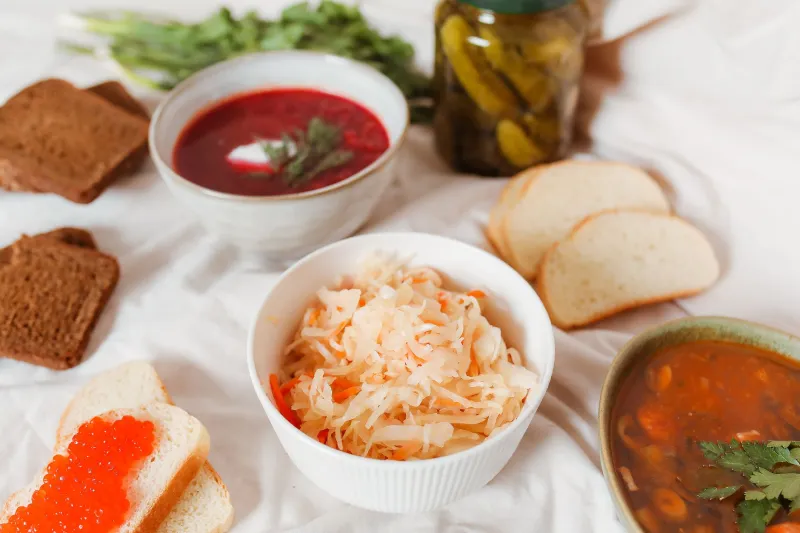
Lacto-fermented vegetables — sauerkraut, kimchi, naturally fermented pickles — go through a cold fermentation process and are never heat-treated. The bacteria present in a good jar of raw sauerkraut are alive, active, and in many cases more diverse than what you'd find in a commercial yogurt. Research has consistently shown that diversity of bacterial strains matters for gut health, not just raw numbers.
A 2016 study published in the Journal of Applied Microbiology found that fermented vegetables can contain anywhere from 1 million to 1 billion CFUs per gram — with certain traditionally prepared kimchi samples testing higher than many commercial probiotic supplements. And because those bacteria are embedded in a food matrix with natural prebiotics (the fiber that feeds them), they tend to survive the journey through your digestive system better than isolated strains in a capsule or processed dairy product.
Homemade yogurt, made with a live starter culture and never reheated, is another strong option. The process is simpler than most people assume — you need milk, a small amount of existing yogurt as a starter, and a warm place to let it sit. What you get is a product with genuinely active cultures, no added sugar, no thickeners, and no mystery shelf-life processing. It's also dramatically cheaper than buying premium probiotic yogurt week after week.
The Markup You're Paying For
Let's be honest about the money side of this. Premium probiotic yogurts in the US regularly run $1.50 to $2.50 per single-serve container, or $6 to $10 for a larger tub. A quality jar of raw, naturally fermented sauerkraut from a farmers market or a brand like Bubbies or Farmhouse Culture costs $5 to $8 and lasts weeks in your refrigerator.
Homemade yogurt, if you're buying good whole milk, costs maybe $1.50 per quart — a fraction of what you'd pay for a branded probiotic version. And the live culture count in your homemade batch, made and consumed within a few days, is almost certainly higher than anything that's been sitting in a supply chain for two weeks.
The premium probiotic yogurt market is worth billions of dollars annually in the US, and a significant portion of that value is built on marketing language that outpaces the science behind it. That's not a conspiracy — it's just how food marketing works. But it means consumers are routinely paying a substantial markup for a benefit that may be minimal or nonexistent.
How to Actually Get Probiotics From Your Food
If gut health is genuinely a priority for you — and there's good reason it should be — here's a more practical approach than loading up on expensive yogurt:
Look for the live cultures seal, and read the fine print. If a yogurt doesn't explicitly state that it contains live and active cultures, assume it might not. Brands like Stonyfield, Siggi's, and Nancy's are transparent about their cultures and use voluntary certification.
Prioritize fermented vegetables. Raw sauerkraut, kimchi, and naturally fermented pickles (not the vinegar-brined kind — check the label) are some of the most reliable sources of diverse, viable bacteria you can buy. Keep them refrigerated and eat them regularly.
Make your own. Homemade yogurt is easy and inexpensive. Homemade sauerkraut is even easier — it's literally just cabbage and salt. There are endless tutorials available, and the results tend to be far more bacterially active than anything commercially produced.
Don't chase CFU numbers. A product advertising 50 billion CFUs isn't automatically better than one with 1 billion. Strain diversity, viability at time of consumption, and the presence of prebiotic fiber all matter more than a big number on a label.
The Bottom Line
Your gut doesn't care about branding. It cares about live, diverse, viable bacteria making it through your digestive system. Commercial probiotic yogurt can be part of a healthy diet, but it's worth being clear-eyed about what you're actually getting — and what you might be overpaying for.
The most effective probiotic foods tend to be the least glamorous ones: a spoonful of sauerkraut with dinner, a bowl of kimchi, a jar of yogurt you made yourself on Sunday. None of them require a premium price tag or a celebrity endorsement. They just require a little attention to what's actually in them — and what's still alive when you eat.