Microgreens Are Supposed to Be Alive When You Eat Them — Most Aren't
Walk into any Whole Foods, farmers market, or upscale grocery chain right now and you'll find a wall of clamshell containers promising you the nutritional equivalent of a multivitamin in plant form. Sunflower shoots. Pea tendrils. Radish microgreens. Broccoli sprouts. The marketing is compelling: these tiny seedlings are harvested at their nutritional peak, containing anywhere from four to forty times the vitamins and antioxidants of their full-grown counterparts.
Except — and this is the part nobody on the label wants to talk about — that "peak" is a moving target. A very fast-moving one. And by the time most packaged microgreens travel from a commercial grow facility to a distribution warehouse to a regional hub to your local store shelf, that window has often already closed.
So what are you actually buying? Let's get into it.
The Science Behind the Sell
The nutritional case for microgreens is genuinely solid. A widely-cited 2012 USDA study published in the Journal of Agricultural and Food Chemistry analyzed 25 commercially available microgreens and found that most contained significantly higher concentrations of vitamins C, E, K, and beta-carotene than their mature vegetable equivalents. Broccoli microgreens, in particular, have become a darling of the longevity crowd thanks to their sulforaphane content — a compound studied extensively for its potential anti-cancer and anti-inflammatory properties.
But here's the thing researchers are careful to note and marketers are careful to omit: those numbers come from freshly harvested greens, typically tested within 24 to 48 hours of cutting. Microgreens are living tissue. Once cut, they begin respiring — consuming their own stored nutrients as energy. Temperature, light exposure, humidity, and time all accelerate that process.
A 2020 study out of the University of Illinois found that microgreens stored at refrigerator temperatures (around 39°F) retained most of their nutrient density for about five to seven days post-harvest. After that, degradation accelerated sharply. By day ten, some varieties had lost 20 to 30 percent of their key phytonutrients. By day fourteen — well within the sell-by window printed on many commercial packages — certain greens had lost nearly half.
From Grow Tray to Your Grocery Aisle: The Timeline Problem
Here's where the supply chain becomes the story.
Large commercial microgreens operations — think facilities growing tens of thousands of trays per week in climate-controlled warehouses across states like California, Texas, and Florida — typically harvest, package, and ship within a 24-hour window. That part sounds great. The problem is what happens next.
After harvest, packaged microgreens often sit in a facility cooler before being loaded onto refrigerated trucks for regional distribution. Depending on where you live, that transit leg alone can take two to four days. They arrive at a regional distribution center, where they may sit another day or two before being routed to individual stores. Then they hit the produce section, where staff rotation varies wildly by location.
We reached out to three independent microgreens growers — two in the Pacific Northwest and one in the Mid-Atlantic — who sell both direct-to-consumer and through retail channels. All three, speaking candidly, said the same thing: by the time their product reaches a grocery shelf in a market two or more states away, they have almost no confidence in the nutrient integrity of what they grew.
"I can grow the most nutrient-dense sunflower shoot you've ever tasted," one Oregon-based grower told us. "But once I hand it off to a distributor headed to Chicago, it's out of my hands. The cold chain breaks. Boxes get stacked wrong. It sits under fluorescent lights for days. At that point, you're basically paying premium prices for a pretty garnish."
What 'Sell By' Actually Tells You (Hint: Not Much)
Sell-by dates on microgreens packaging are set by the producer, not regulated by any federal standard. There's no USDA or FDA requirement governing how these dates are calculated. Most are set based on visual quality — meaning the greens still look good — not nutritional content. A container of pea shoots can look perfectly green and perky while having already burned through a significant portion of its sulforaphane or vitamin C reserves.
The visual cues you can trust: yellowing at the base of stems, a slimy texture on leaves, any off-putting smell, or stems that have gone limp and won't spring back when touched. Those are signs of serious degradation. But "looks fine" is not the same as "nutritionally intact."
So Are Locally Grown Microgreens Actually Different?
Generally, yes — meaningfully so, if you can access them.
A microgreens grower operating a small farm or urban grow operation within 50 to 100 miles of your market is working with a fundamentally different timeline. Harvest-to-shelf can be measured in hours rather than days. Many small producers harvest to order, meaning your greens were still in a tray that morning.
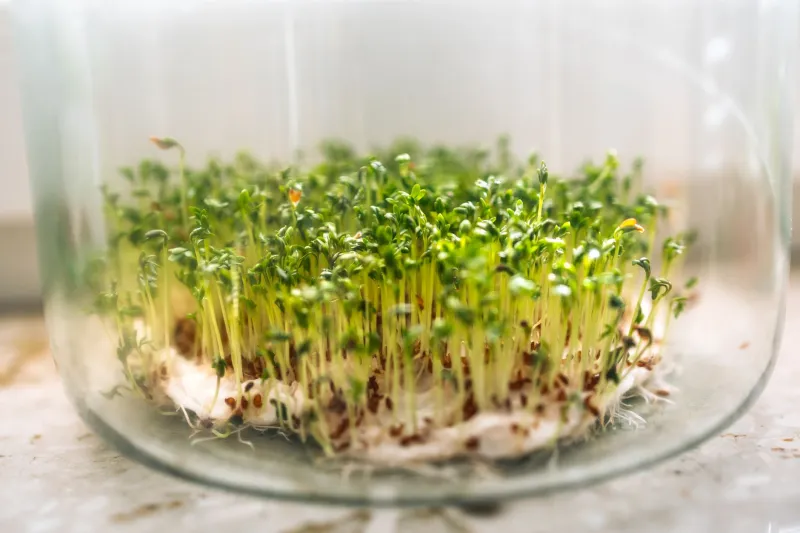
Farmers markets are your best bet here. Talk to the vendor. Ask when they harvested. Ask how they store their trays. A grower who brings living trays (roots still attached, soil still present) to market is giving you something genuinely different from pre-cut clamshells — those greens are still pulling nutrients from the root system right up until you snip them yourself at home.
CSA boxes with a local microgreens add-on are another solid option, particularly if the farm is within a short drive of your home. Several subscription services have also emerged that ship live trays overnight — still rooted, still growing — which largely solves the nutrient degradation problem, though at a price point that isn't accessible for everyone.
Growing Your Own: The Obvious Answer Nobody Wants to Say Out Loud
Look, we know "just grow them yourself" can feel like a preachy non-answer. But when it comes to microgreens specifically, it's genuinely one of the most practical food suggestions we can make. These are among the easiest crops a beginner can grow. You don't need a yard, a garden bed, or even much counter space.
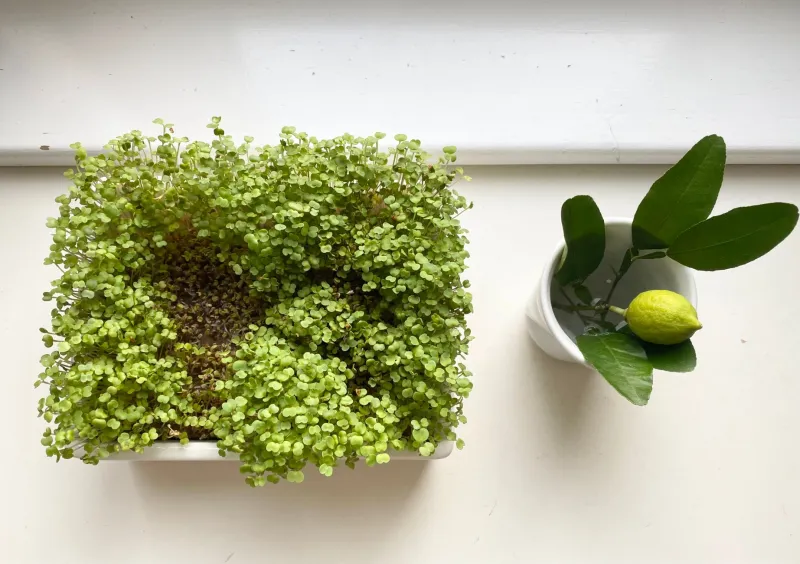
A basic setup — a shallow tray, a grow medium (coconut coir works great and is more sustainable than peat), seeds, and a sunny windowsill or a single cheap grow light — runs about $30 to $50 upfront. Seeds for popular varieties like sunflower, radish, broccoli, and peas are inexpensive in bulk. Most microgreens go from seed to harvest in seven to fourteen days.
You harvest exactly what you need, exactly when you need it. The nutritional gap between a microgreen cut five minutes ago and one cut five days ago is not subtle — you can taste it.
Practical Checklist: Buying Microgreens You Can Actually Trust
If growing your own isn't in the cards right now, here's how to shop smarter:
- Buy local first. Farmers markets, food co-ops, and small natural grocers with regional sourcing are your best options.
- Ask the harvest date, not just the sell-by date. Any reputable small producer should be able to tell you when their greens were cut.
- Choose live trays over pre-cut clamshells whenever possible. Roots-intact means the plant is still metabolically active.
- Skip the greens that have been on the shelf longest. Check the back of the display for the most recently stocked product.
- Avoid any package with condensation pooling inside — that's a sign of temperature fluctuation during transit, which accelerates degradation fast.
- Eat them within two to three days of purchase, not within the printed sell-by window.
The microgreens industry isn't doing anything technically illegal. But there's a meaningful gap between what's being sold and what's being delivered — nutritionally speaking. Knowing that gap exists is the first step to making sure you're actually getting what you paid for.
Because "living superfood" shouldn't be a marketing category. It should be a description.