From Dirt to Dinner Table: Why Regenerative Farming Might Be the Most Important Thing on Your Plate
The Ground Beneath Everything
Here's something most nutrition labels will never tell you: the health of the soil your food grew in has a direct line to the health of your gut. Not metaphorically. Literally. The microbial ecosystems living in well-tended, regeneratively managed soil produce nutrients, minerals, and bioactive compounds that eventually make their way into your body — and the science on this connection is getting harder to ignore.
Regenerate agriculture has moved well beyond niche farming circles. It's showing up in grocery co-ops in Portland, at farmers markets in Atlanta, and on the menus of farm-to-table restaurants from Vermont to California. But what does it actually mean — and why should it matter to someone just trying to eat well and live clean?
Let's dig in.
What Regenerative Agriculture Actually Is (And What It Isn't)
Regenative farming isn't a single certification or a tidy checklist. Think of it as a set of practices designed to do more than sustain the land — they actively restore it. Where conventional agriculture depletes soil over time (through tillage, synthetic fertilizers, and monocrops), regenerative methods work with natural systems to rebuild organic matter, improve water retention, and increase biodiversity above and below ground.
Core practices typically include:
- No-till or minimal-till farming — preserving soil structure and the fungal networks within it
- Cover cropping — planting off-season crops to protect and feed the soil
- Rotational grazing — moving livestock in patterns that mimic natural herd behavior, allowing pasture to recover
- Composting and reduced synthetic inputs — feeding soil biology rather than bypassing it
- Integrated crop-livestock systems — bringing animals and plants back into the same ecological loop
The result? Soil that's alive. Teeming with bacteria, fungi, protozoa, and nematodes — a microscopic world that determines how well your food actually nourishes you.
The Soil-Gut Connection: More Than a Metaphor
Researchers at institutions like the Rodale Institute and the University of Vermont have been building a compelling case that soil microbiome diversity directly influences the nutritional density of crops. Plants grown in biologically rich soil produce higher levels of antioxidants, polyphenols, and trace minerals. They're also less stressed — and less-stressed plants don't need to spend their energy fighting off disease, so they invest more in the compounds that benefit whoever eats them.
For your gut, this matters enormously. A growing body of research — including work published in journals like Nature Microbiology and Frontiers in Nutrition — links diverse dietary phytonutrients to a more resilient human microbiome. When your gut has a wide variety of microbial strains to work with, you see downstream benefits in immune regulation, inflammation response, mood, and metabolic health.
Simply put: healthy dirt grows food that feeds healthy gut bugs. It's one of the most elegant feedback loops in nature.
Farms Doing It Right: Four Regenerative Operations Worth Knowing
White Oak Pastures — Bluffton, Georgia This fifth-generation family farm has become something of a flagship for American regenerative agriculture. Owner Will Harris transitioned from conventional cattle farming in the 1990s and now runs one of the most biodiverse operations in the Southeast — raising ten species of livestock using rotational grazing, with zero synthetic inputs. Their carbon footprint data, independently verified by a 2019 study, showed that their beef actually sequesters more carbon than it emits. That's not greenwashing. That's soil science.
Singing Frogs Farm — Sebastopol, California Paul and Elizabeth Kaiser have built a no-till vegetable operation that consistently outproduces neighboring conventional farms — without tilling, without synthetic fertilizers, and with dramatically higher organic matter in their soil year over year. Their model has been studied by UC Davis and cited in regenerative ag literature worldwide. What they grow is genuinely more nutritious, and the data backs that up.
Gabe Brown's Ranch — Bismarck, North Dakota Gabe Brown is practically a legend in regenerative circles. His 5,000-acre operation in North Dakota runs on five principles of soil health: minimize disturbance, maintain living roots, keep soil covered, maximize diversity, and integrate livestock. The results after two decades? Soil organic matter that went from 1.7% to over 11% — a transformation that took most of his neighbors' land centuries to achieve naturally.
Hawthorne Valley Farm — Ghent, New York This biodynamic and certified organic farm in the Hudson Valley has operated since 1972 and remains a model of integrated agriculture. They run a CSA, a creamery, and an educational center — connecting consumers directly to regenerative food systems and closing the loop between farming and community wellness.
How to Find Regeneratively Grown Food Near You
Here's the honest truth: there's no single USDA-certified "regenerative" label yet, though organizations like Regenerative Organic Certified (ROC) and the Savory Institute's Land to Market program are working to change that. In the meantime, here's how to shop smarter:
- Look for ROC certification on products — it's the most rigorous standard currently available and requires organic certification as a baseline
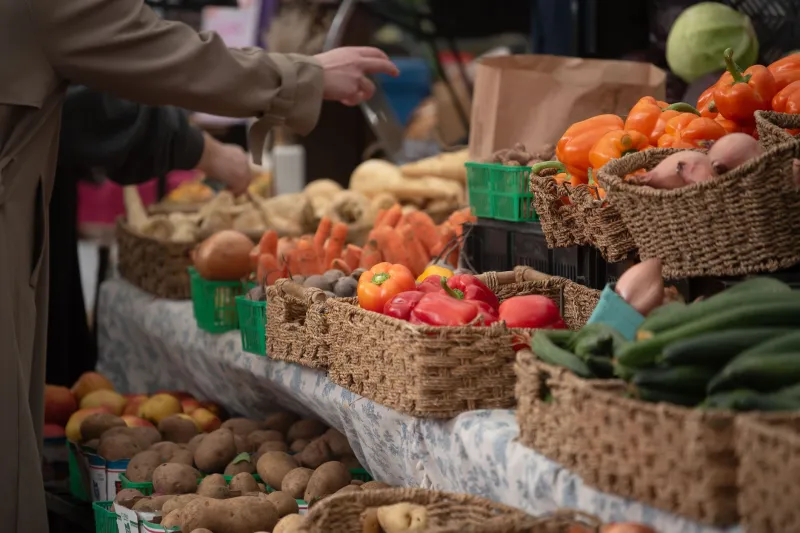
- Shop your local farmers market and ask questions — farmers who practice regenerative methods are usually proud to talk about their soil. Ask about tillage, cover crops, and whether they use synthetic inputs
- Join a CSA (Community Supported Agriculture) from a farm you've researched — many list their farming practices on their websites
- Use the Land to Market Ecological Outcome Verification (EOV) seal on meat and dairy products — it verifies that the land producing your food is improving, not declining
- Apps like Farmish and websites like LocalHarvest.org can help you locate farms near you that align with regenerative principles
Your Fork Is a Vote — And a Healing Tool
Choosing regeneratively grown food isn't just an environmental statement. It's a personal wellness decision backed by emerging science. Every dollar you spend on food from farms that build soil sends a signal to the market, funds practices that pull carbon out of the atmosphere, and — perhaps most directly — puts more nutritionally complex, microbiome-friendly food into your body.
The industrial food system spent the last 70 years treating soil like a medium for delivering synthetic nutrients to plants. Regenerative farmers are making the case — loudly and with data — that the soil itself is the nutrient. And when you eat food grown in living, breathing, biologically rich earth, you're not just feeding yourself.
You're participating in a cycle that's been running for millennia. You're just finally getting back in step with it.
Want to find a regenerative farm near you? Start at LocalHarvest.org or check out the Regenerative Organic Alliance at regenorganic.org.